Sony HX9V Test & Video Review - or Why You Don't Need a DSLR for Your Nature Videos
Have you been looking for a small camera that could possible replace your DSLR? Specifically when taking trips in which weight and big size of the cam might be an issue?
Well, the new Sony HX9V might be the camera you've been looking for. Update: Check out the improved Sony HX30V. It's awesome for short outdoor nature videos and also for small scale video productions.
Topics
video gear review
Could You Survive The Wild? 8 Essential Wilderness Survival Tips
Would you survive a night on your own in the wild? Most people can’t honestly answer ‘yes’ to that question because they wouldn’t be prepared to handle the unexpected.
Here you’ll learn some basic survival concepts and essential tips in case you ever need to brave the wild.
Tip #1: Always prepare to spend the night outdoors.
Far too many outdoor adventurers make the error of optimism. They prepare for the best case scenario make the mistake of omitting the “what ifs”. Even when embarking on a simple day outing, you should have all the gear you’ll need to survive the night.
Tip #2: The basic needs are warmth, water, sleep and food.
A high-quality sleeping bag will help ensure warmth and sleep. You should also have lighters protected in a waterproof container as well as knowledge of where you can acquire dry wood in the event of wet conditions.
Additionally, know where your fresh water sources are in the area, and have plenty food on hand, such as trail mix and protein bars. We can survive a long time without food, but those energy sources can make survival much easier.
Tip #3: The right equipment can go a long way.
Highly useful gear to have handy on your adventure includes a first aid kit, compass, map of the area and signals, such as a whistle, signal mirror, aerial signals, light sticks and emergency flares.
Other helpful items include waterproof matches with tinder, a flashlight, bandana (to cover your head from scorching sun or even as a bandage if you get injured), thread and needle, lip balm, sunscreen and insect repellant (you don’t want those bugs to eat you alive!).
Tip #4: Practice makes perfect.
Reading about wilderness survival techniques is a good first step, but it is not enough. It is very difficult for a novice to apply theory in an actual emergency.
Practice and familiarity are crucial. Practice starting a fire and using the various safety equipment, and consider taking a wilderness survival course.
Tip #5: Choose your shelter site with care.
Optimally, a shelter site should be flat, dry and well drained. It should be a convenient distance from water and firewood. However, do not choose a site too close to water because of insects, flash flooding and other dangers.
Tip #6: The three stages of fire building are tinder, kindling and fuel.
Good tinder is dry and ignites with only a spark: grass, leaves, paper, bark and even resin. Kindling is highly combustible material that you add to the burning tinder. Dead branches and materials from the underside of trees and bushes work best. Once the kindling burns, add your fuel, which generally consists of large dry pieces of wood.
Tip #7: Know how to navigate.
It is one thing to be able to follow a compass and use a map, but it is also relatively easy to navigate via the sun, moon, North Star, Southern Cross, wind and even moss growth on trees and other foliage. Most courses cover these skills.
Tip #8: Know how to find and prepare water.
If you don’t have water or a limited source, finding more is your priority. Conserve water by avoiding direct sunlight and heat, and then use your map or head downhill following cues, such as moist ground, animal tracks and so forth.
Keep these tips in mind on your next outdoor venture and you’ll be all the more prepared to face whatever unexpected situation that lies ahead.
| About the author: Jason Thompson has been publishing articles online for more than a decade, and many of them deal with the great outdoors and tips for passing the hunter safety course California requires. He has had survival training, and is a skilled hunter, angler and boater. |
Photo source: Total Film
Topics
survival
MTB T Shirt - Dirt Bike Rider Vector Design
Download this mountain bike vector in:
- SVG format
- EPS format
- High resolution PNG image (with transparent background)
Also, some people contacted me about using the drawing I used to illustrate the tutorial on how to design cycling jerseys. Someone wanted to use it for his mountain bike shop logo, another athlete wanted to have it for a poster announcing a mountain biking event, etc. The funny thing about it is that since so many people downloaded it and used it - it may no longer appear original.
So, my advice to you, if you want to use these drawings for your non-commercial projects, is to do some extra work and edit them in Inskape (the .SVG files). This way you make sure what you get is original and it's not something you can find all over the internet...
You can actively support Highball Blog by buying mountain bike shirts or by sharing these posts with your friends on Facebook, Twitter and Google+. A write up on your blog would be highly appreciated as well. This way, you help me continue to post the tutorials, the T shirt drawings and the outdoor gear giveaways.
Thank you for reading this! I appreciate your time spent on this blog!
Download this MTB shirt design in:
- SVG format
- EPS format
- High resolution PNG image (with transparent background)
Get this mountain bike T shirt design in:
- SVG format
- High resolution PNG image (with transparent background)
Download this MTB drawing in:
- SVG format
- High resolution PNG image (with transparent background)
Wear your helmet and protect your bike from thieves!
Topics
bike T-shirt
,
free stuff
How To Build Your DIY Camera Slider for Smooth Outdoor Video Capture - Tutorial & Test Video
Update: DIY GoPro Mount for Camera Slider (I upgraded the dolly with bolts as legs)
Those smooth video shots - how do they get that?!
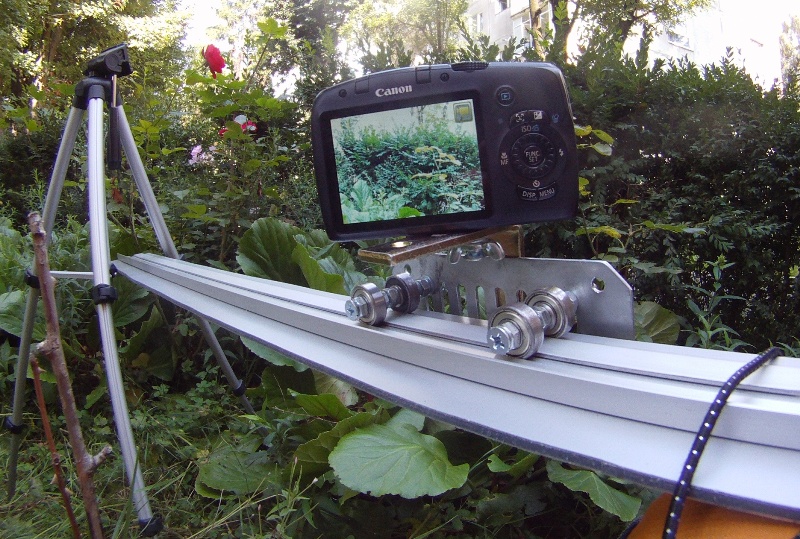
Simple. They use a camera slider which is nothing more than a rail of some sort on which the camera plate slides.
Now, professional camera sliders start at a couple of hundred dollars and the price goes up if the rail is longer. Some of them also have a small motor which allow you to shoot sliding time lapse videos - of course those are even more expensive (some going higher than $1000 ).
As an amateur filmmaker, the camera slider was the next thing I had to build after my DIY steadicam. Basically the lower camera plate in my current design of the camera stabilizer inspired me to build my DIY camera slider.
Now I use it to shoot videos for our solar panels installation services in Germany and Belgium.
Watch the video below to see the shots I was able to get.
The deep water solo climbing clip below also has a few scenes shot with the slider (the first version, without the aluminum rails).
Materials you'll need for your mini camera dolly
The list can vary according to your own input on the design and functionality of the slider. This is just what I had:
- A base for the rails which can be made of aluminum (wide and thick flat stock), Alubond or laminate flooring. I happened to find Alubond on a construction site and I used for a GoPro HD camera mount as well. If you want a light and robust material this is it - look for a local distributor and maybe you can get some scraps for free (like I did).
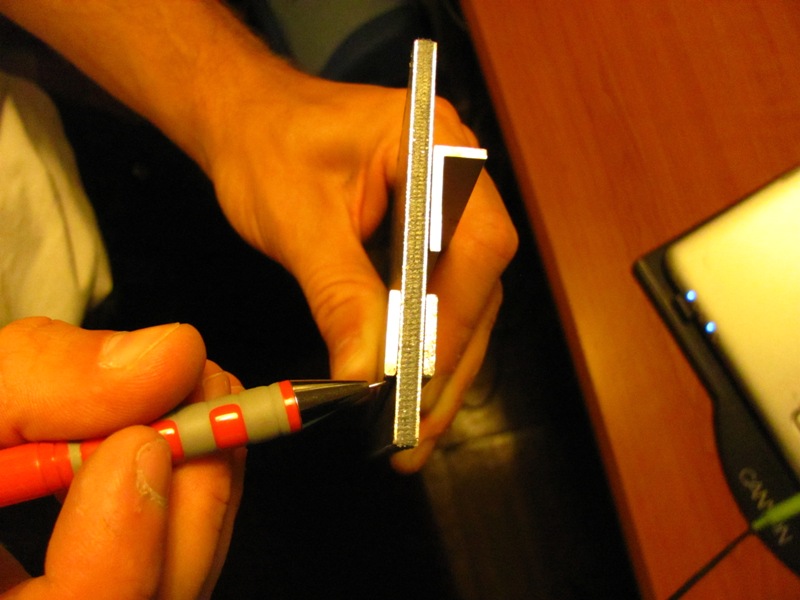
- Thin and light flat stock for the rails. Use 2 mm think aluminum plates. Also add an L profile piece for making the base more rigid. The longer the base, the higher its tendency to bend when weight is placed on it (such as your camera).
- Resin glue - Bison Power Adhesive in my case.
- Bolts and nuts (locking nuts and wing nuts).
- Ball bearings - whatever you find at your local store. As long as they're small and light, and can be fixed on bolts with locking nuts, they're good for your DIY project.
- Metal piece shaped like an L as your camera mount. Make sure it has holes through which a 6 mm thick bolt can pass - you'll use an improvised tripod mount bolt to secure your camera on the sliding piece.
- Plate with channels made of any material you find fit. Mine is machine worked, made if iron sheet but I'm planning to make a new one out of Alubond. Anyway, if you can't have it machine made, make one from laminate flooring and use a jigsaw to make the channels for the bolts (you can also use a milling cutter/milling drill bit for the channels).
How to make your DIY slider
The images and video speak for themselves but here are my tips:
- Use as few elements as possible. Example: Have two bearings fit an aluminum flat stock instead of having two aluminium flat stock pieces to fit a bearing when creating the rails.
- Leave a tiny gap between the bearing and the rails. This grants a better slide and less friction.
- You don't need a rail below the base. I thought I needed one but there was too much drag so I set the bearings further apart so they won't touch the rail at all. Now the aluminum piece below the base only ads weights to the rig - but it also makes the base more rigid so that's a plus.
- Add glue only in the middle of the flat stock so when you press them on the base, no glue will get out. You wanna keep the rolling surface as clean as possible for super smooth video shots.
Tiny gap between the bearing and the aluminum rail
(slightly loose fit) - this enables the bearing to roll easily
Sliding cart & camera holder
Conclusion
I need to make some legs for the rail for faster set up when preparing to shoot but for the moment I use it as it is. I improvise with my backpack and my tripod but it can be anything: a rock, a tree, a fence, etc.
Also some stoppers would be nice - you don't want your camera to fall off the rail once it reaches the end.
A system to place the slider on a tripod in definitely necessary and I'm gonna update this article as soon as I implement a solution for this particular slider.
So far, I'm pleased with the shots I get so I guess I'm gonna use it more in my extreme sports & outdoor videos.
Over to you
- How do you find this system? Simple? If not, why?
- What's your preferred tool when shooting video, other than your camera? Mine is the glidecam.
- Do you have any other tips regarding shooting video on a slider?
Topics
DIY
DSLR Steadicam - DIY Camera Mount Tutorial
Test Video - Shot with My DIY Steadicam
Everything I know about building a DIY steadicam is now is in this new guide. Learn how to get amazing cinematic video with this cool gadget that you can build using parts from your local hardware store.
If you don't like the material, no worries. I'll give your money back and you get to keep the guide. Guaranteed!
Do you have a DSLR camera and want smooth video footage?
As a filmmaker, you're probably interested in getting gliding shots in order to convey that movie-like sensation to the viewer.
-----
Since I'm no longer selling the DIY Highball steadicam, you may wanna check out these other camera stabilizers. Click on any picture.
Check out the stabilizers on Amazon Canada, Amazon.UK and Amazon.DE.
-----
Even though I only own a GoPro HD and a compact camera, I built a DSLR steadicam by simply modifying the camera plates in my DIY glidecam.
You can place any type of video gadget that has a threaded hole for tripod on this DIY camera mount.
It's advisable to build the plates out of 4 to 6 mm thick aluminum as to have them sturdy and light. I used a sandwich type material for the top plate - 4 mm thick, having two outer aluminum sheets and a plastic core.
These sheets are normally used for outside building facades or for interior fixtures.
The brand name (which is used as a generic name as well) for the aluminum composite panel is Alubond.
The bolt heads are buried in the top plate. This enables you to place any type of camera on the stabilizer. The 8 channels take some weight of the plate and also give you more flexibility as to where to place your camcorder.
That's why at least the top plate must be machine worked out of a thicker material. The rest of the plates can be thinner.
Use 4 bolts and self locking nuts to assemble the camera mount.
The middle channel in the thinner plate is for the threaded shaft that goes through the DIY gimbal. The other two channels make the plate lighter and, if necessary (when using and ultralight camera), you can add extra weights (bolts and washers fixed with wing nuts).
If the rig is correctly balanced and yet too lightweight, there may be a problem when flying your camera at faster speeds: the shaft will tilt due to wind. So keep it a little heavy for good inertia and stable smooth video capture.
To balance the steadicam, loosen the big wing nut below the thin plate and slide the camera forward or backward. To adjust the position of the camera, loosen the improvised tripod hole bolt and slide the camera sideways. You can also turn the camera sideways (lens facing lateral side) if that's how you want to shoot.
I recommend you to have the plates made in a shop so every cut, every hole and every channel is perfectly aligned with the rest of the elements.
If you can't have them made in a shop and don't have aluminum plates (or other similar materials like plastic sheets, etc) you can use laminate flooring. Click on the above image for larger view (you can print it out to have it as a reference).
We could't shoot video with the DSLR (Canon 60D) because we didn't have enough weights to balance it (extra weights were needed for the lower narrow plate).
However, it is challenging to hold such a heavy rig for extended periods of time. Now that I've tried it, I understand why a vest and an articulated arm are a must for long hours video shooting.
Go out there and shoot your outdoor adventures. Cheers!
Everything I know about building a DIY steadicam is now is in this new guide. Learn how to get amazing cinematic video with this cool gadget that you can build using parts from your local hardware store.
If you don't like the material, no worries. I'll give your money back and you get to keep the guide. Guaranteed!
Do you have a DSLR camera and want smooth video footage?
As a filmmaker, you're probably interested in getting gliding shots in order to convey that movie-like sensation to the viewer.
-----
Since I'm no longer selling the DIY Highball steadicam, you may wanna check out these other camera stabilizers. Click on any picture.
-----
Even though I only own a GoPro HD and a compact camera, I built a DSLR steadicam by simply modifying the camera plates in my DIY glidecam.
You can place any type of video gadget that has a threaded hole for tripod on this DIY camera mount.
It's advisable to build the plates out of 4 to 6 mm thick aluminum as to have them sturdy and light. I used a sandwich type material for the top plate - 4 mm thick, having two outer aluminum sheets and a plastic core.
These sheets are normally used for outside building facades or for interior fixtures.
The brand name (which is used as a generic name as well) for the aluminum composite panel is Alubond.
It consists of two layers of aluminium skins in varying gloss levels of 30% to 80% sandwiching a Polyethylene or fire rated core. The top surface is coated in stove enameled structural lacquering system and back surface has a mill finish or stove lacqured polyester lacquering system.I got them on a construction site (hotel) and the workers were masking the elevator door frame with it. One side has a nylon sheet and once you're done shaping and bending your piece, you just peel off the nylon and you've got yourself a clean looking aluminum surface.
The bolt heads are buried in the top plate. This enables you to place any type of camera on the stabilizer. The 8 channels take some weight of the plate and also give you more flexibility as to where to place your camcorder.
That's why at least the top plate must be machine worked out of a thicker material. The rest of the plates can be thinner.
Use 4 bolts and self locking nuts to assemble the camera mount.
The middle channel in the thinner plate is for the threaded shaft that goes through the DIY gimbal. The other two channels make the plate lighter and, if necessary (when using and ultralight camera), you can add extra weights (bolts and washers fixed with wing nuts).
If the rig is correctly balanced and yet too lightweight, there may be a problem when flying your camera at faster speeds: the shaft will tilt due to wind. So keep it a little heavy for good inertia and stable smooth video capture.
To balance the steadicam, loosen the big wing nut below the thin plate and slide the camera forward or backward. To adjust the position of the camera, loosen the improvised tripod hole bolt and slide the camera sideways. You can also turn the camera sideways (lens facing lateral side) if that's how you want to shoot.
I recommend you to have the plates made in a shop so every cut, every hole and every channel is perfectly aligned with the rest of the elements.
If you can't have them made in a shop and don't have aluminum plates (or other similar materials like plastic sheets, etc) you can use laminate flooring. Click on the above image for larger view (you can print it out to have it as a reference).
We could't shoot video with the DSLR (Canon 60D) because we didn't have enough weights to balance it (extra weights were needed for the lower narrow plate).
However, it is challenging to hold such a heavy rig for extended periods of time. Now that I've tried it, I understand why a vest and an articulated arm are a must for long hours video shooting.
Here are two sample videos shot with this current version of my DIY camera stabilizer:
Hanging out with local bloggers outside my city & climbing session - Social Media Brasov
Shooting video on inline skates for a bike tricks video project - I took a nice fall.
For more detailed pictures check out my Facebook album. Feel free to ask me questions in the comments.
Go out there and shoot your outdoor adventures. Cheers!